Qiu Jiongjiong Premieres Mythological Feast Film at Tokyo Festival
The director of A New Old Play presents a 135-minute anthology of four stories spanning 2,000 years, linked by celestial figures and a focus on dining.
By Yasmin Farouk ·
Qiu Jiongjiong, the Sichuan-born writer and director, premiered Fuxi: Four Tales of Feasting in competition at the Tokyo Film Festival. The film follows his 2021 feature A New Old Play, a work that received positive reception. Qiu’s new project runs 135 minutes, a reduction from the three-hour duration of his previous film.
The narrative structure comprises four distinct segments that explore more than 2,000 years of Chinese myth and history. Each story centers on specific meals or banquets. Intertitles explain that the word fuxi functions as both a noun for delicious food and a verb for savoring delicacies.
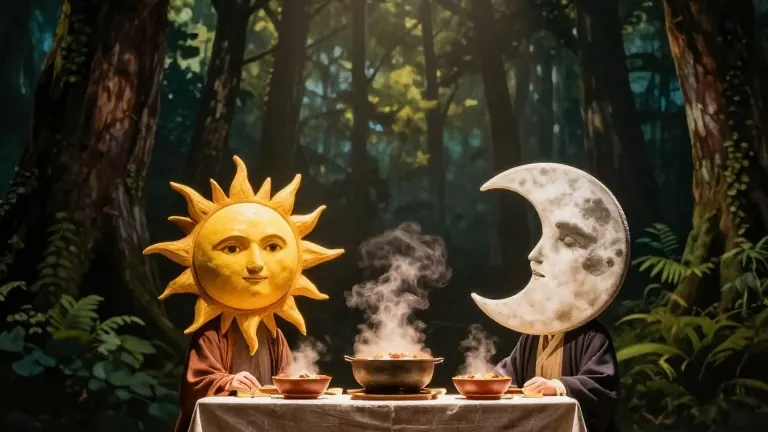
A framing device connects the disparate tales through the presence of Sol, played by Wen Ke, and Luna, played by Xiao Luxi. Both characters wear large headpieces shaped like the sun and the moon. The plot also incorporates a film crew that is producing the stories within the movie, though the on-screen credits do not always match the actual end credits of the production.
The first chapter depicts prehistoric ancestors with long tails that they consider sacred food. An aged matriarch, portrayed by veteran Taiwanese actor Lee Kang Sheng, has her tail removed and stewed for the community as she dies. The second segment features King Wang, the fourth king of Sichuan, who abdicates his throne and transforms into a cuckoo bird. He returns annually to consume a prepared meal.
Fan Guang Yao portrays King Wang in this segment. The third chapter is set during China’s medieval period and focuses on the poet and gastronome Su Dongpo, played by Lee Hong-Chi. A group of fantastical creatures gathers to honor his memory. These include a Harvester, a water spirit named Yaksha, a woman known as Granny Spring Dream, and a fox in human form.
Wang Yitong plays Su’s book boy, who prepares dishes associated with his master for the dinner party. Scenes from Su’s life are performed during the meal. Su’s honesty often caused conflict with authorities, leading to multiple periods of exile. The fourth and final tale takes place in the early 20th century during the fall of the Qing dynasty.
Zhou Jiarui plays the servant boy Zhang Sanxing, who witnesses the political transition. The Harvester, Yaksha, and Fox join him in eating food while he transitions to the land of the dead. The film concludes with the cast and crew celebrating at a wrap party. The dialogue is reportedly delivered in the Sichuan dialect, which may present challenges for international viewers relying on English subtitles.
The production is credited to Uluka Studio Ltd., Hongkong Spark Peak Entertainment Group Ltd, and several other companies. David Tang, Ding Ningyuan, and Zhao Jin served as producers. Robbin Feng Yuchao and Goopi Liu Tailin directed the photography. Bai Yun designed the costumes, and Diao Lili composed the music. The film mixes slapstick comedy with solemn themes, using theatrical sets and stylized performances.
Source: The Hollywood Reporter