Forensic expert says Jeffrey Epstein's death was more likely homicide, challenging suicide ruling
A leading forensic medicine specialist who reviewed never-before-published autopsy records says the injuries documented on Epstein's body point away from suicidal hanging.
By News Media House Staff ·
A forensic medicine expert who spent months examining unpublished autopsy records provided by Jeffrey Epstein's brother has concluded that the disgraced financier's 2019 death in federal custody was more likely a homicide than a suicide, directly challenging the official ruling by the New York City Office of Chief Medical Examiner.
Dr. Freeman, editor-in-chief of the Journal of Forensic and Legal Medicine and a professor of forensic medicine, presented his findings Monday in London alongside Anders Eriksson, a professor of forensic medicine at Umea University in Sweden, and Itiel Dror, a researcher who specializes in identifying bias in forensic decision making. Freeman said he believes Epstein was attacked and killed by another person in August 2019.
"The injuries that were documented by the medical examiner were not consistent with the suicidal hanging. And the injuries that were attributed to something other than potentially a physical struggle or assault were just overlooked," Freeman told CBS News, citing his review of the autopsy records, photographs and a biomedical reconstruction he produced. His report is the second by an outside expert to question the official findings; in 2020, Epstein's brother hired forensic pathologist Dr. Michael Baden, who said neck injuries raised doubts about suicide and pointed more toward murder.
Freeman said he was struck from the first image he examined, which showed ligature wounds on Epstein's neck. While one mark fit the classic description of a hanging injury, he identified a second mark beneath it, angled differently. "There is no mechanism to produce a second mark that would be lower," he said, arguing that even a ligature tied with two loops would pull upward toward its anchor point. He also dismissed the idea of a false start, saying Epstein would have needed an attempt strong enough to break his hyoid bone and thyroid cartilage while remaining conscious. "That's not what suicidal hangings do," he said.
To test the suicide hypothesis, Freeman built a biomechanical analysis using three-dimensional models matched as closely as possible to Epstein's anatomy, based partly on the account of corrections officer Michael Thomas, who said he found Epstein hanging from a bedpost. The model showed that some neck abrasions were consistent with suicidal hanging, but others were not, including a deep soft tissue hemorrhage in the left shoulder and an injury on his back. "We have too many other injuries that are not explained by any suicidal hanging," Freeman said.
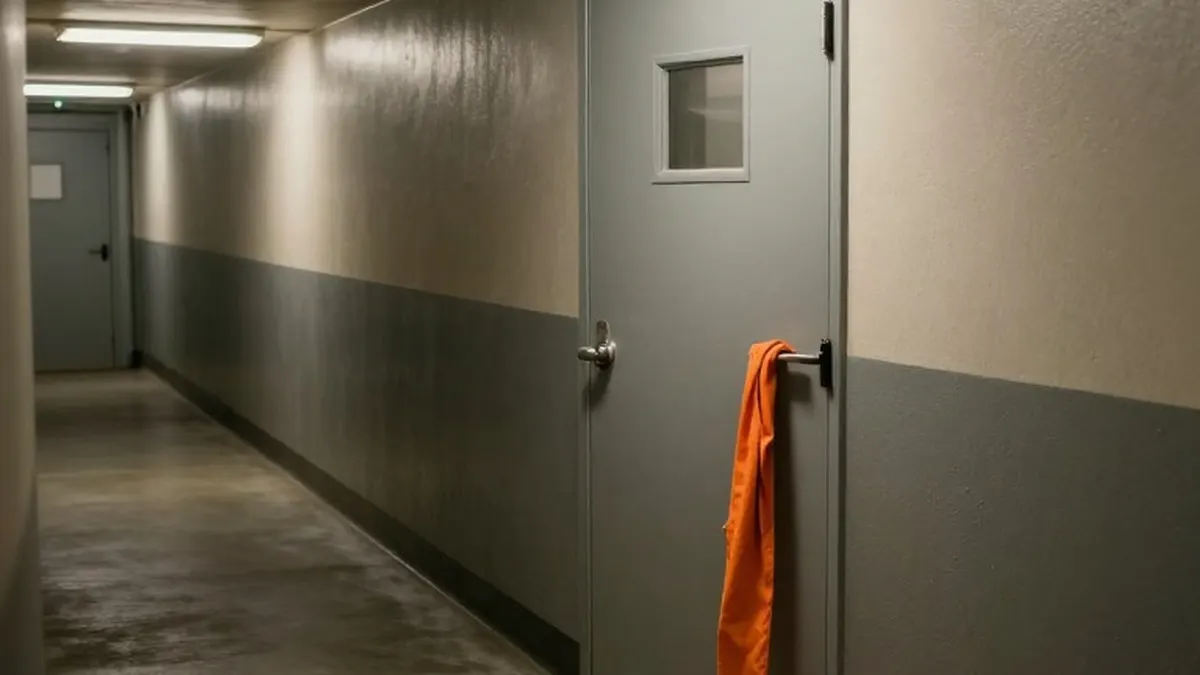
Instead, Freeman proposes strangulation. He said horizontal marks on the neck suggest a ligature pulled from behind, and pointed to a double-knotted, looped strip of torn orange bedding fabric found in the cell, which he said could account for an irregular abrasion at the back of the neck. He also cited what he described as signs of assault and struggle: blunt force trauma to the face and left shoulder and apparent fingernail marks above the ligature line. That fabric, he noted, was never collected by the medical examiner, and he said the ragged, segmented pattern of the wounds did not match the noose taken from the room.
The medical examiner's office, which performed the autopsy on Aug. 11, 2019, the day after Epstein was found dead, declined an interview request and did not respond directly to Freeman's findings. "Our office stands by its determination," a spokesperson said. That ruling has drawn support elsewhere: a June investigation by The New York Times, based on tens of thousands of pages of newly released documents and handwritten material from jail, reported indications Epstein had been contemplating taking his own life, and found that almost none of the forensic experts interviewed believed the manner of death could be conclusively settled on medical evidence alone. Freeman acknowledged his own report was rejected by an academic journal, whose reviewers felt it inappropriate to criticize a medical examiner in a peer-reviewed publication; he said he plans to resubmit.
Epstein's death investigation was widely criticized as flawed. Justice Department records show none of the guards on duty spoke to medical examiner investigators, and some falsified records and lied about their activities. Thomas, credited with finding the body, agreed to be interviewed only after being criminally charged two years later, giving a statement in exchange for leniency. Epstein's body was moved within minutes, preventing accurate scene photography, the cell was never sealed for forensic work, and most cameras in his wing were not functioning. Investigators also failed to pursue some details, including an unexplained figure seen ascending a staircase on the night of the death.
Freeman, who has testified in high-profile cases and served on a Maryland Attorney General's audit team reviewing in-custody deaths, said the true open questions concern who may have killed Epstein and why the cameras were off. "Was this a suicide? Not a mystery," he said.
Originally published by News Media House
More News · National news · Report a business · Got a Story?