Ireland Under Pressure Over Alumina Shipments to Russia
A 400-foot cargo ship carried alumina from a Russian-owned plant in County Limerick to St. Petersburg while European leaders debated sanctions in Dublin.
By Ryan Carter ·
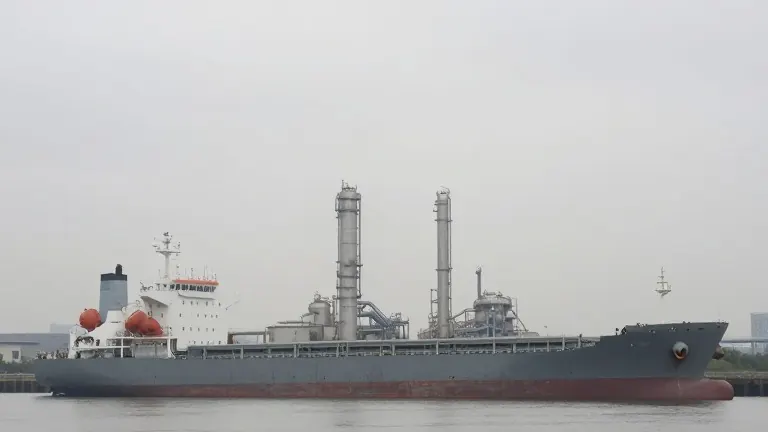
The Karin, a 400-foot cargo ship, left Ireland’s River Shannon estuary this week bound for Russia with a cargo of alumina. The white powder, refined from bauxite ore, is a primary ingredient in aluminum, which is used to make everything from toothpaste and lipstick to missiles and drones. The ship is one of many that regularly transport the substance from the Aughinish refinery in County Limerick to Russian ports, including St. Petersburg.
The refinery is Europe’s largest alumina processor and is owned by Rusal, a Russian aluminum producer. Rusal was founded and is still part-owned by Oleg Deripaska, a sanctioned oligarch with ties to President Vladimir Putin. According to the U.S. and Australian governments, Rusal produces nearly all of Russia’s aluminum. Since Moscow launched its full-scale invasion of Ukraine in 2022, two other major alumina factories in Australia and Ukraine stopped exporting to Russia, reducing Russian supplies by about 40%, according to a 2026 report by the Economic Security Council of Ukraine.
With those other sources gone, Ireland has become a critical supplier. The Ukrainian council estimates that roughly 17% of Rusal’s alumina supply now comes from Aughinish. Activist group Alumina 22 calculated that between March and October this year, Irish exports to Russia totaled 491,307 metric tons. An investigation by the Organized Crime and Corruption Reporting Project and the Irish Times found that alumina from Aughinish is smelted in Russia into aluminum, which is then sold to a metals trading company that supplies Russian defense contractors.
Ivana Bacik, leader of Ireland’s opposition Labour Party, said the material is clearly ending up in military supplies. “It would be unthinkable for Ireland to be contributing, even in that indirect way,” she said, referring to Russia’s war machine. Her party supports a temporary nationalization of the refinery, a move similar to Ireland’s seizure of banks during the 2008 financial crisis, to halt exports to Russia.
The issue dominated discussions this week in Dublin, where dozens of European leaders gathered for the European Political Community summit and a subsequent EU leaders meeting. EU foreign policy chief Kaja Kallas said she would speak with Irish Foreign Minister Helen McEntee on Thursday to understand where the negotiations stand. Irish government minister Niall Collins told The Associated Press that there is “absolutely no evidence” the material is ending up in military supply chains, though the government has not made public the findings of its investigation.
Aughinish Alumina stated in a release that its product has no connection to the Russian military supply chain. The company hired an independent firm to conduct monthly audits for Irish authorities to provide enhanced traceability. Enterprise Minister Peter Burke, who oversees sanctions enforcement, said in July that it was impossible to prove Rusal’s claim that Irish alumina is only used to make aluminum for export from Russia. The Irish government handed its findings to the European Commission, which drafts sanctions packages.
David O’Sullivan, the EU sanctions envoy, said last month in Dublin that there is little doubt the alumina goes to Russian smelters that produce materials for the military-industrial complex. “I’ve read the government report. Personally, I think there’s no doubt the investigative journalists got it right,” he said. The European Parliament passed a non-binding motion in July calling for a ban on alumina exports to Russia, but the substance was not included in the bloc’s 21st sanctions package that same month.
Sanctions require unanimous agreement from all 27 EU member countries. A European Commission spokesperson described the policy as a delicate balance between thwarting Russia’s war effort and limiting negative impacts on member nations, noting that alumina is a critical raw material. Irish Minister for European Affairs Thomas Byrne said the issue comes up regularly in EU discussions. “If ever there were to be a proposal of that from the European Commission, Ireland would certainly consider it,” he said on Thursday.
In Foynes, the port town next to the plant, many residents work at Aughinish or know someone who does. Joe Hanlon, a retired docker, said the business is too large for the government to close down easily. “Too much employment for the government to get involved,” he said. Yet he added that if Ireland wants to stop the war on Ukraine, it should take action.
More News · Charlotte news · Report a business · Got a Story?