Gaza residents spin scrap metal into wind power as grid fails
With solar panels costing up to $5,000, displaced families rely on homemade turbines built from debris to charge phones and run medical devices.
By Yasmin Farouk ·
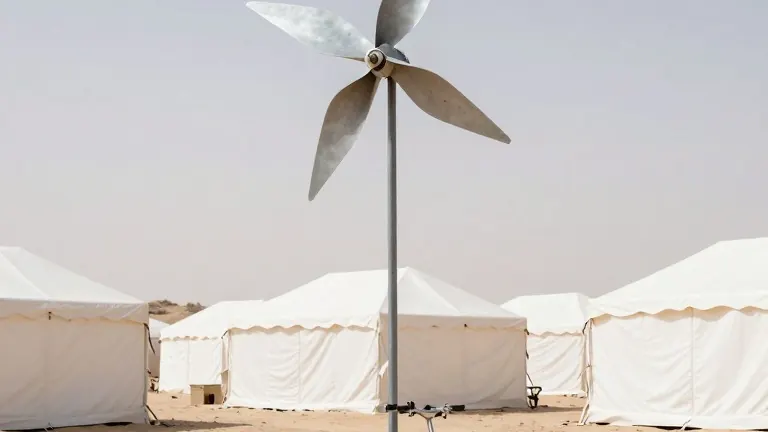
Homemade wind turbines built from scrap metal now supply electricity to displaced families in Khan Yunis, Gaza, after the territory's power grid collapsed. The turbines, constructed from salvaged parts, spin in sea breezes above a camp of tents, providing a critical energy source in a region where the grid is no longer functional.
The World Bank reports that more than 90 percent of Gaza’s power generation and distribution capacity was destroyed in April 2026. Much of the damage resulted from Israeli military strikes during the war that began with the Hamas attack on southern Israel on October 7, 2023. Most residents now live in displacement, cut off from the remaining infrastructure.
Kamal Al-Dabary, a 60-year-old former engineering student, designs the turbines for local families. He works from a plastic table, twisting cables and testing components with a multimeter. The devices use scooter motors and blades cut from old water tanks. When the wind turns the blades, the motor generates electricity that is stored in batteries.
Al-Dabary said he turned to wind power after the cost of solar panels became prohibitive. A single panel now costs at least 15,000 shekels, or nearly $5,000, according to Al-Dabary. He noted that prices have risen sharply over the past three years as supplies entered Gaza through Israeli-controlled crossings.
"We haven’t had work or income for three years," Al-Dabary said. "That’s when the idea of a wind turbine came to mind. Why not harness the wind? So we salvaged parts from the rubble."
The generated power allows residents to charge phones, run fans, and operate electric razors. It also supports medical equipment, such as nebulizers, which are essential for treating children at night. Saleh ben Hasan, a 50-year-old resident, said the system "has changed everything" because healthcare access is limited. "If a child needs a nebulizer in the middle of the night, who else can we turn to?" he asked.
Nearly all of Gaza’s residents were displaced at least once during the conflict. Most currently live in a small area under Hamas rule, while Israel controls more than half of the territory along the perimeter. The turbines provide a modest output, but they offer a reliable source of energy in a camp where shortages are constant.
Source: The Times of Israel