Vance on Hospital Translators: Everyone Should Speak English
The vice president argued that resources spent on translation in emergency rooms could be better used to hire more doctors, a stance that contrasts with census data on limited English proficiency.
By Nathan Reed ·

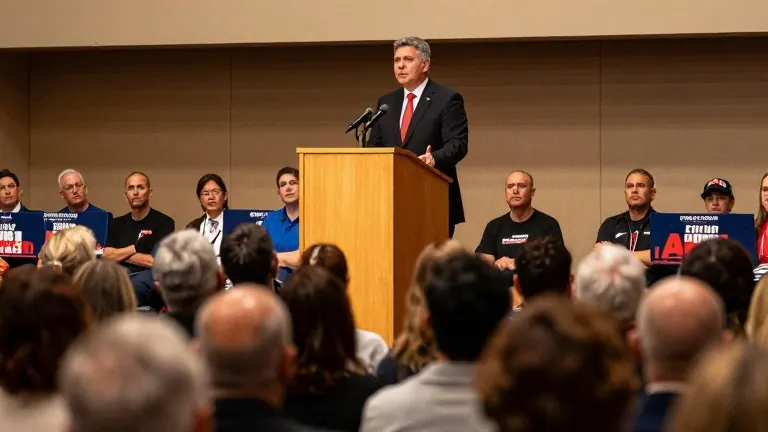
Vice President JD Vance told a Fox News audience on Thursday night that U.S. hospitals should hire more doctors instead of translators. He made the remark while discussing how to preserve the national identity during a period of mass immigration. Vance, whose wife is the daughter of immigrants, described a specific incident in an emergency room where he observed nine translators available for nine different languages. He stated that he was worried about a medical problem his son was facing during that time. His question to the room was direct: why not have everyone speak English so the country could focus on medical care rather than translation?
The vice president framed the issue as a matter of adaptation for newcomers. He said that anyone wanting to be American should learn the culture and values of the country. He described this assimilation as the bare minimum expectation for a person new to the United States. The audience applauded his comments, which centered on the idea that a common language simplifies daily life and medical interactions. Vance suggested that the current system places a burden on families who need immediate medical answers.
Federal data provides a different picture of the population. A U.S. Census Bureau survey indicates that more than 8% of Americans have limited English proficiency. That figure represents roughly 25 million people who have a limited ability to read, speak, write, or understand English. These individuals rely on interpreter services to communicate effectively in daily life. The number highlights the scale of the language diversity Vance addressed in his town hall appearance.
Healthcare professionals point to research showing the value of these services. Studies indicate that adequate medical interpreter services improve the quality of care for patients. They also help reduce health disparities and lower the rate of medical errors. When patients can fully understand their diagnoses and treatment plans, outcomes tend to be better. The availability of translators in emergency settings is a standard practice in many U.S. hospitals to ensure safety and clarity for all patients.
The comments align with recent actions by the Trump administration. The administration has pursued an America First agenda that includes promoting English as the dominant language. President Donald Trump signed an executive order last year declaring English the official language. He also revoked a 2000 executive order signed by Bill Clinton that expanded access to services for people with limited English proficiency. Trump argued that a shared language benefits the country, though experts note that fluency can take five to eight years to achieve.
The legal status of English in the United States remains complex. The federal government does not have a statutory law that designates an official language. Executive orders can be changed or revoked by future presidents. While the U.S. requires English proficiency for citizenship, exemptions exist for older applicants. Vance’s remarks add a personal dimension to this ongoing policy discussion about language and national identity.