Study suggests ancient stone collection shaped human memory
Researchers from Tel Aviv and Oxford universities link 500,000-year-old artifacts to the development of personal identity and source monitoring.
By Yasmin Farouk ·
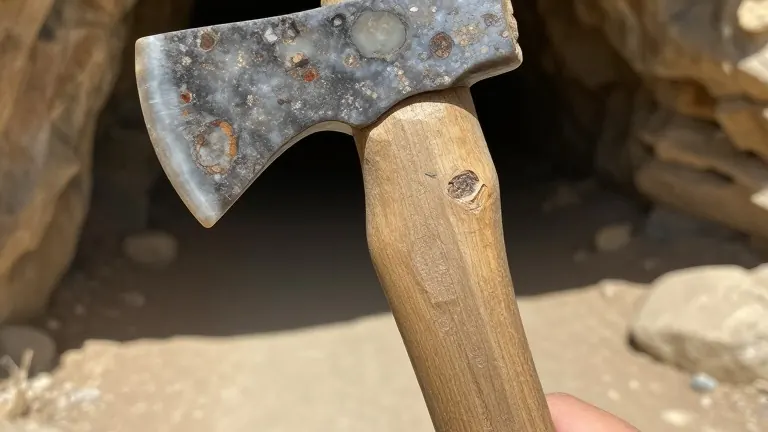
Researchers from Tel Aviv University and Oxford University propose that early humans began collecting unusual stones and worn tools roughly 500,000 years ago to reinforce personal memory. The team published their findings in the journal Evolutionary Anthropology, arguing that these portable objects helped distinguish firsthand experiences from imagined or learned stories.
The study draws on archaeological evidence from Qesem Cave in Israel, which was occupied between 420,000 and 200,000 years ago. Dr. Yoav Ram, Prof. Ran Barkai, Dr. Ella Assaf, Prof. Liad Mudrik and Dr. Bar Efrati analyzed small, colorful pebbles that prehistoric people carried from distant locations. In the Sakhnin Valley, the team identified handaxes made from flint that retained fossils or distinctive geological features in prominent central positions, making them visible and tactile.
Archaeologists also recovered older flint tools at Revadim, Jaljulya and Qesem Cave. These items had weathered over time, developing a patina that altered their appearance. While some were sharpened again, most preserved their aged surfaces and signs of previous craftsmanship. The researchers suggest these visible markers of age contributed to the objects' value to their owners.
Prof. Barkai linked this behavior to environmental shifts that forced early humans to adapt their hunting strategies. As large animals such as elephants disappeared, hunters had to learn techniques for tracking smaller, faster prey like fallow deer and wild cattle. Objects gathered in these new landscapes may have helped preserve a connection to the specific grounds on which their livelihoods depended.
The hypothesis centers on source monitoring, the cognitive ability to identify where a memory originates. Portable keepsakes could be shown to others, lending credibility to accounts of alliances, gifts, and territorial rights. The team argues that repeated reliance on these objects over generations increased evolutionary pressure on brain systems that assess memories, helping people organize experiences into a continuous personal history.
The authors note that their explanation remains a scientific hypothesis rather than proof that every unusual artifact was a souvenir. They cannot determine whether individuals kept specific items throughout their lives or passed them to later generations. Barkai acknowledged that scholars who responded to the study did not all agree with its conclusions.
The team plans to investigate how modern brains respond when handling ancient objects. Barkai suggested using electroencephalograms or functional MRI scans on participants of different ages and backgrounds to explore the relationship between material keepsakes and memory processes.